What is Real Hand Safety | Hand Safety in the Workplace
HandHelmet — Because hands are not tools.
Hand safety in the workplace is one of the most critical yet overlooked aspects of industrial safety. Across construction, manufacturing, oil & gas, logistics, warehousing, and heavy engineering, hand injuries remain among the most frequent recordable incidents.
Cuts, crush injuries, fractures, pinch-point accidents, and amputations often occur not because workers ignore safety — but because their hands enter the line of fire.
Real hand safety in the workplace is not about reaction.
It is about elimination of exposure.
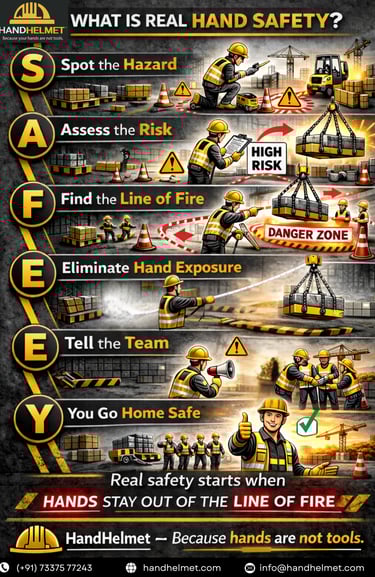
This is where the S.A.F.E.T.Y. framework becomes practical, field-ready, and preventive.
Why Hand Safety in the Workplace Matters
According to global occupational safety data, hand injuries account for a significant percentage of lost-time incidents in industrial environments. The hands are involved in nearly every task:
Guiding suspended loads
Positioning materials
Handling tools
Adjusting machinery
Stabilizing components
When hands are used as control tools near moving or suspended objects, risk increases dramatically.
True hand safety in the workplace requires redesigning how tasks are executed — not simply reminding workers to “be careful.”
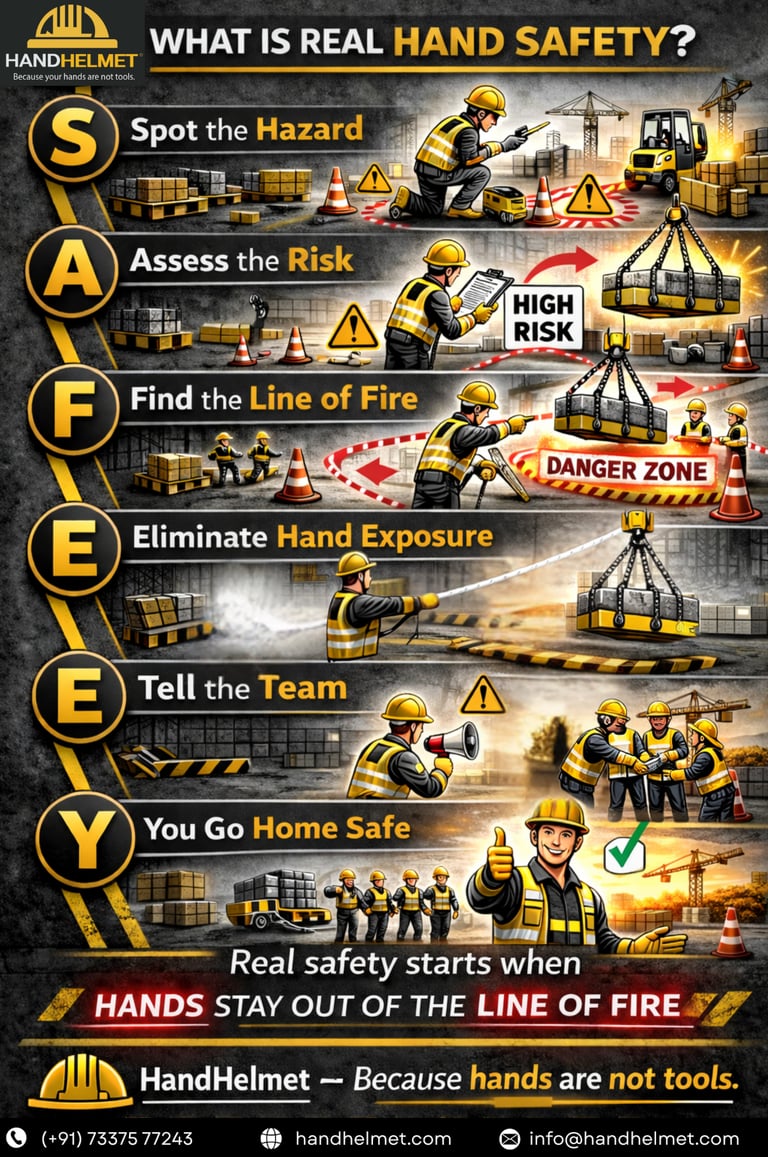
The S.A.F.E.T.Y. Framework for Hand Safety in the Workplace
S – Spot the Hazard
Every safe task begins with hazard identification.
Before starting work, ask:
Is there a suspended load?
Are there pinch points?
Could materials shift or roll?
Is energy stored in slings, chains, or equipment?
Spotting hazards early prevents hands from entering dangerous zones.
Hand safety in the workplace starts with awareness — but does not stop there.
A – Assess the Risk
After identifying hazards, evaluate exposure severity:
What is the load weight?
What happens if control is lost?
Where will the load move if it swings?
Is anyone inside the drop zone?
If hands are required near unstable loads, crush points, or mechanical movement, the risk level is high.
Risk assessment ensures that exposure is identified before injury occurs.
F – Find the Line of Fire
The “line of fire” refers to the path an object will take if it moves unexpectedly.
This includes:
Swing radius of crane loads
Drop zones
Pinch and crush points
Snap-back zones of tensioned rigging
Many workplace hand injuries occur because workers underestimate motion.
Hand safety in the workplace demands predicting movement before it happens.
If hands are inside the projected path of movement, exposure exists.
E – Eliminate Hand Exposure
This is the most powerful step.
The most effective hand safety strategy is not protection — it is elimination.
Eliminating hand exposure means:
Using push-pull tools
Using taglines instead of direct hand guiding
Maintaining safe stand-off distance
Engineering hands-free load control methods
Gloves protect against cuts.
Distance protects against crush injuries.
Real hand safety in the workplace is achieved when hands are kept out of the line of fire entirely.
T – Tell the Team
Workplace safety is collective.
Miscommunication during lifting, rigging, or positioning tasks leads to unexpected movement and sudden exposure.
Effective communication includes:
Pre-task briefings
Clear role assignment
Confirmed signals
Hazard awareness discussion
When teams operate with shared situational awareness, the risk of hand injuries reduces significantly.
Y – You Go Home Safe
The goal of hand safety in the workplace is simple:
Every worker returns home without injury.
Hand injuries affect:
Productivity
Morale
Insurance costs
Project timelines
Long-term worker health
Prevention protects both people and performance.
Real Safety Starts When Hands Stay Out of the Line of Fire
The most advanced safety systems focus on hierarchy of controls:
Elimination
Engineering controls
Administrative controls
PPE
Hand safety in the workplace improves dramatically when organizations shift from reliance on PPE to engineered hands-free solutions.
If a task requires hands near:
Suspended loads
Moving machinery
Heavy materials
Tensioned rigging
The method must evolve.
Hands are not tools.
They are irreplaceable.
Final Thoughts on Hand Safety in the Workplace
Real hand safety in the workplace is proactive.
It requires:
Hazard identification
Risk assessment
Line-of-fire awareness
Elimination of hand exposure
Team coordination
Leadership commitment
When these elements align, injuries decline, productivity improves, and safety culture strengthens.
Don’t let your hands become the next incident—commit today to staying out of the line of fire.
HandHelmet — Because hands are not tools.
📞 +91 7337577243
🌐 Visit handhelmet.com
📩 info@handhelmet.com
Contact
+91 7729990663
info@handhelmet.com
handhelmet.com