If You Can Reach It — It Can Injure You: The Hidden Risk in Lifting Operations
In industrial environments, danger doesn’t always announce itself loudly. Sometimes, it sits right in front of you — within arm’s reach — disguised as a routine task.
3/27/20262 min read
If You Can Reach It — It Can Injure You: The Hidden Risk in Lifting Operations
In industrial environments, danger doesn’t always announce itself loudly.
Sometimes, it sits right in front of you — within arm’s reach — disguised as a routine task.
And that’s exactly where the problem begins.
The “One Second” Mistake
Most hand injuries in lifting operations don’t happen because workers lack training or awareness.
They happen because of a simple, dangerous assumption:
“It’ll just take a second.”
A worker reaches out to steady a suspended load.
Maybe it’s slightly off balance. Maybe it needs a quick adjustment.
That one moment — that one decision — is all it takes.
Because suspended loads are unpredictable.
They shift.
They swing.
They react to forces you can’t always see.
And when they move, they don’t give warnings.
Understanding the Real Hazard: Pinch Points & Crush Zones
When dealing with cranes, hoists, or rigging systems, one of the most underestimated risks is the pinch point.
A pinch point is any area where a body part — often fingers or hands — can get caught between:
A moving load and a fixed surface
Chains, hooks, or rigging equipment
Two shifting objects
The result?
Severe injuries such as:
Crushed fingers or hands
Fractures
Permanent disability
In many cases, these injuries are irreversible.
And the harsh reality is — they are almost always preventable.
Why Hands Should Never Be Used
Hands are instinctive tools. We use them without thinking.
But in lifting operations, that instinct becomes a liability.
Here’s why:
Zero reaction time: Loads can shift faster than you can pull away
Unpredictable motion: Even stable loads can suddenly swing or rotate
Force multiplication: The weight involved is far beyond human resistance
Simply put:
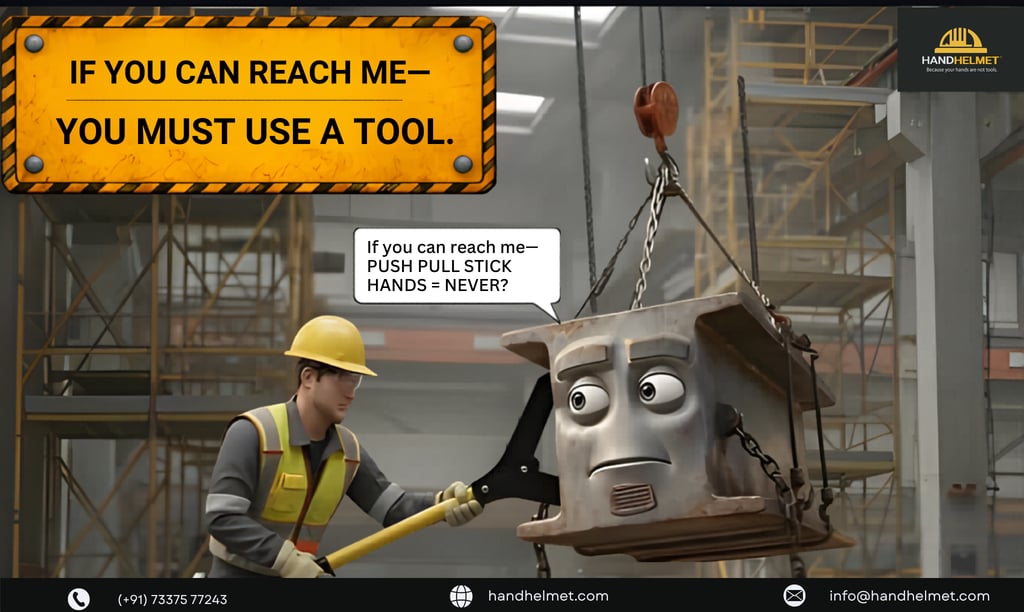
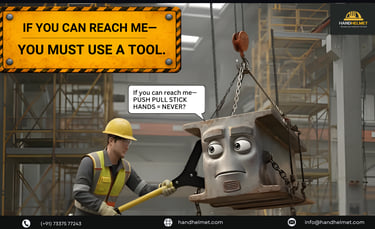
If you can reach the load, you are already in the danger zone.
The Safer Alternative: Use Tools, Not Hands
The safest and most effective way to control a suspended load is by maintaining distance.
This is where push/pull tools (tag lines, sticks, or guide tools) come in.
They allow workers to:
Guide loads without direct contact
Maintain a safe working distance
Reduce exposure to pinch points
This small adjustment in behavior creates a massive reduction in risk.
Safety Is a Habit — Not a One-Time Decision
Workplace safety isn’t defined by policies written on paper.
It’s defined by the choices made in real-time.
Especially the small ones.
Choosing not to rush
Choosing not to “just adjust it quickly”
Choosing to use the right tool every single time
Because accidents don’t require repeated mistakes.
They only require one.
A Simple Rule That Saves Hands
Let’s reduce it to a rule that’s impossible to forget:
Hands are NOT tools. Ever.
If a task involves a suspended load, your hands should never be the solution.
Distance is safety.
Tools are control.
Discipline is protection.
Final Thought
Deadlines come and go.
Tasks get completed.
Work shifts end.
But injuries stay.
The next time you’re about to reach for a load, pause for a second and ask:
“Is this worth my hand?”
Because the safest workers aren’t the fastest or the most experienced.
They’re the ones who never compromise on the basics.
Upgrade your hand protection with gear engineered for real-world risks.
HandHelmet — Because hands are not tools.
Experience protection that performs where it matters most.
📞 +91 7337577243
🌐 Visit handhelmet.com
📩 info@handhelmet.com
Contact
+91 7729990663
info@handhelmet.com
handhelmet.com