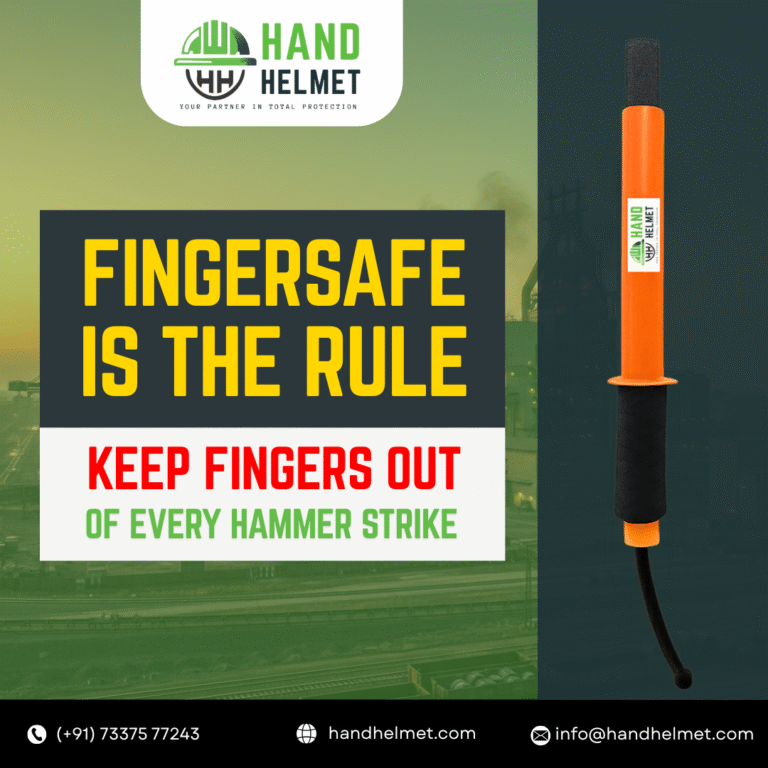
FingerSafe Is the Rule: Keep Fingers Out of Every Hammer Strike
Hand Injury Prevention for Steel Mill Operations by HandHelmet
In a steel mill, hammer strikes are routine—but hand injuries should never be. Every day, maintenance crews, fitters, and operators place components, align parts, or adjust assemblies while heavy hammers deliver high-impact force. In that brief moment between alignment and impact, fingers enter pinch zones, moving parts, and strike paths. One missed angle, one vibration shift, or one rushed strike is enough to change a life permanently.
That is why HandHelmet introduces a rule—not a suggestion: FingerSafe is the rule. Keep fingers out of every hammer strike.
This is not just about tools. This is about hand injury prevention as a system, embedded into steel mill operations.
The Reality of Hand Injuries in Steel Mills
Steel mills operate in environments defined by:
High-impact forces
Heavy components
Heat, vibration, and noise
Tight tolerances and confined workspaces
Hammering is unavoidable during:
Forging and forming adjustments
Maintenance and shutdown activities
Liner fitting, wedge setting, and alignment tasks
Structural positioning and temporary holding
The risk emerges when hands are used as positioning devices. Fingers enter pinch points between metal surfaces, moving parts, or under impact zones—often because there is no safer alternative available at the moment.
Gloves alone do not solve this problem. PPE reduces severity, but hand injury prevention requires distance.
Why Hammer Strikes Create Extreme Finger Risk
A hammer strike in a steel mill is not a simple action. It involves:
High kinetic energy transfer
Unpredictable rebound or vibration
Sudden component movement under load
Limited visibility in confined spaces
When fingers are close to the strike zone:
Pinch forces multiply instantly
Reaction time is eliminated
Crush injuries occur before the brain can respond
This is why most severe finger injuries happen during routine tasks, not exceptional events.
FingerSafe Is the Rule – A New Standard for Hand Injury Prevention
HandHelmet FingerSafe is designed around one principle: If a hammer moves, fingers must not be there.
This is not a behavior-based reminder. It is a hands-free safety control engineered to remove fingers from danger zones entirely.
By enforcing distance between the hand and the strike point, FingerSafe transforms how steel mill teams approach hammering and alignment tasks.
Engineered for Steel Mill Conditions
FingerSafe is developed by HandHelmet Hands Free Safety Tools engineers, with direct input from heavy industry environments. It is built to perform where steel mills demand the most.
Key Features That Matter on the Shop Floor
Guards fingers from pinch zones and moving parts FingerSafe acts as an extension between the worker and the load, keeping hands out of crush points, strike paths, and shifting components.
Designed with high-durability materials Engineered to withstand impact forces, vibration, heat exposure, and rough handling common in steel mill operations.
Easy integration into industrial workflows No complex retraining. No productivity loss. FingerSafe fits seamlessly into existing maintenance and operational processes.
This makes hand injury prevention practical, not theoretical.
From Tool to Rule: Changing Safety Culture
Steel mills succeed when safety rules are clear, enforceable, and measurable. FingerSafe supports safety leadership by enabling:
A no-hands-in-strike-zone rule
Standardized hammering and alignment procedures
Reduced reliance on personal judgment in high-risk moments
Consistent compliance across shifts and teams
When FingerSafe becomes the rule, workers no longer decide whether to keep fingers away—the system does it for them.
Why Hand Injury Prevention Demands Hands-Free Solutions
Data consistently shows that the most serious hand injuries occur when:
Workers feel “in control” of the task
The job is considered routine
Time pressure overrides caution
Hands-free safety tools remove this conflict entirely. By design, FingerSafe ensures that distance is maintained every time, regardless of urgency or habit.
This is the future of hand injury prevention in steel mills—engineering controls first, behavior second.
The Cost of One Hammer Strike Is Too High
A single finger injury can result in:
Lost workdays and productivity
Permanent disability
Regulatory scrutiny
Increased insurance and compensation costs
Long-term impact on workforce morale
Compared to these costs, adopting a FingerSafe rule is not an expense—it is a safeguard.
Conclusion: Make FingerSafe the Rule in Your Steel Mill
Hammer strikes will never disappear from steel mill operations. Finger injuries can.
By adopting HandHelmet FingerSafe, steel mills move from reactive safety to preventive control, from awareness to enforcement, from injury response to true hand injury prevention.
FingerSafe is the rule. Keep fingers out of every hammer strike.
If safety is non-negotiable, then neither is FingerSafe.